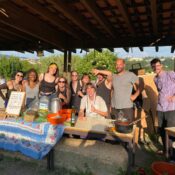
The venue chosen for the seminar was the school’s event space. It had been equipped by the school administration with a computer, video projector and projection screen for the powerpoint presentation to the participants and a board had been brought in from PRAXIS Serres for the presentation of the flip charts. The chairs were arranged in a circular arrangement. At the back of the space, on the library side, a desk had been placed, on which Dixit cards were scattered. On the side of the space, another desk had been placed, on which the cards with the metaphors were scattered.
1. Welcome:
The participants were asked to sit in a circle. Who we are and what we do. Introducing ourselves as “practitioner coaches” representing PRAXIS Serres. A brief description of the 21 st Century Coaching program that we attended, information about the guide and where they can find it, as well as a brief explanation of the seminar that they are going to attend – what are the goals and what is the purpose.
2. Team building:
Activity with a thread. The participants were asked to stand up, go to the library area and make a circle. A facilitator holds the thread, says her name and a virtue that she believes she has. Then she throws the thread to someone else, but holds the end of the thread. Once everyone has spoken, we ask them to observe the thread and express what they think about its formation. After everyone has spoken (those who wish) the trainer begins to move and change positions while continuing to hold the thread. Then the participants are asked to express their observations in relation to these changes.
Conclusions. We leave the thread on the floor, maintaining the formation that was created and return to our original positions.
3. Presentation (Flip chart + PowerPoint) on the definition of coaching, what its forms are, what coaching is NOT (Georgia).
Interaction with the participants. Brainstorming. Emphasis on the fine line between coaching and psychotherapy. Clarification that coaching can be used as a tool in psychotherapy by a mental health specialist (psychologist, psychotherapist), but is not psychotherapy in itself, nor is the coach a psychotherapist. Also, great importance was given to understanding that it does not deal with the past, but with the present and the future. How the past can be mentioned and used only as a point of reference and not for identifying traumas.
Clarification of the concepts of mentor – coach.
4. Presentation of S.M.A.R.T. & G.R.O.W. tools (Flip chart + PowerPoint).
The participation of the trainees was very important. They expressed questions, as well as the need to apply the tools to real examples and their application in the school community. Emphasis was placed on understanding how the tools are multidimensional and are not used only in one direction. How they are tools that the teacher can use for himself and the goal setting of his lesson (per teaching hour, but also per school year), by the teachers for the parents, by the teachers for the students, by the administration for the teachers, how they are tools that can be used individually or in groups. I asked for help from Georgia.
5. Team building:
1st exercise: We are standing, placed in a circle. One person speaks and says “I like….”, whoever agrees with the proposal takes a step forward. When the activity is over, the positive points that such an activity can offer the group were discussed, through a dialogical discussion.
6. Active listening:
1st exercise: The trainer starts and says the phrase “I will go on a trip and in my suitcase I will put a toothbrush” and asks the next participant to say the same phrase and then add another object (e.g. I will go on a trip and in my suitcase I will put a toothbrush and toothpaste). Each participant is asked to say the phrase that the previous one has said, adding an object.
We do 2 circles. At the end of the activity, the participants were asked to share their experience. They were then asked to say which skills they thought were needed for the specific activity. After an interactive discussion, it was emphasized that each activity always requires and cultivates more than one skill. An example was also asked for teaching activities in a school classroom and it was mentioned that always, in any subject taught, the skills that are cultivated are vocabulary enrichment, communication, ICT skills. 2nd exercise: After finding their partner from the team building activities, the participants stand up in pairs and are asked to stand one behind the other. The one in front holds their hands behind their back and the other passes their hands in front of the first one and makes gestures while their partner speaks, which match what their partner says. After the activity, there was a discussion about the skills they thought they needed to have, the level of difficulty of the exercise, and how interesting they found it.
These 2 exercises were the preparation to introduce the concept and importance of active listening. PowerPoint presentation.
Break: Participants were asked to take a 10-minute break and at the end of the time to return with a glass of water/coffee/juice/tea, either empty, full, or half-full, and with an object that caught their interest and symbolized something for them.
Georgia Tsiaousi and Lena Delliou