Outcomes:
They feel more empowered to express themselves and pursue goals.
Ιndividuals set personal goals and work toward them with guided support.
Increased emotional intelligence and self-awareness.
Participants may become better prepared for job interviews and workplace settings.
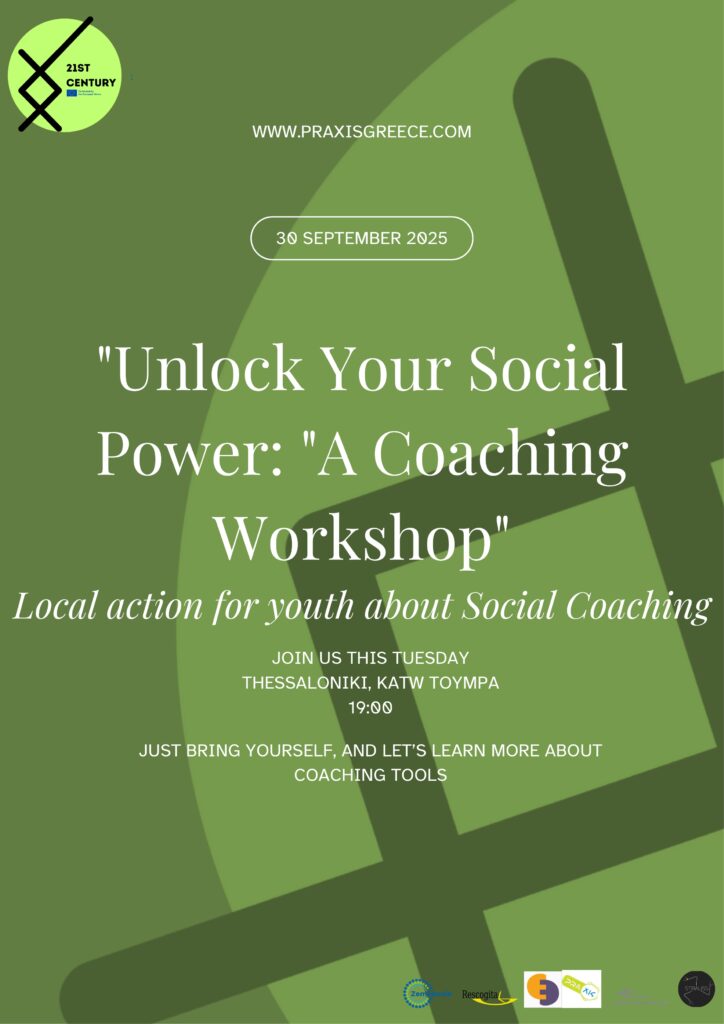
Report + Description of 21 CENTURY Activities
In this local action, the main goals were to introduce participants to the world of Erasmus+ and the concept of Social Coaching.
More broadly, the activity was designed as a simulation of two training course sessions, providing participants with a hands-on experience—whether or not they had previously taken part in an Erasmus+ program (such as a youth exchange or training course). To set the tone, the session began with an icebreaker/energizer called “Two Truths and One Lie”.
This well-known game fosters a friendly and open environment, encouraging participants to connect and learn more about one another. Following the icebreaker, participants were introduced to the scope and opportunities offered by Erasmus+, which were explained in clear categories. A key element of the session was the presentation of the three types of education (formal, non-formal, and informal), with a special focus on non-formal education. Since many people are not familiar with this educational approach, the aim was to help participants understand its value—especially for those who have not experienced it before.
After laying this foundation, the concept of Social Coaching was introduced in a theoretical manner. Basic questions were addressed, such as: What is social coaching? Who can practice it? Under what conditions can it be effective? Many participants brought their own experiences to the discussion, which led to a rich and insightful group conversation about the balance required in social coaching, the environment in which it takes place, key principles, and theoretical frameworks. In the second part of the session, participants explored and practiced two major tools used in social coaching.
This was done to give them a practical understanding of what happens in a coaching session and to allow them to experience the power of these tools firsthand. The first tool, The Wheel of Life, was introduced before a short 15-minute break. The session then continued with the second and final tool: the SWOT Analysis. Through the implementation of these tools, participants experienced a simulated coaching session. The objective was not only to introduce the tools but to create an environment where individuals could confront their own thoughts and emotions, leading to personal reflection and realization. It is important to note that participants were not asked to share their results or express their thoughts and feelings publicly. The intention was to allow them to engage with the tools freely and privately, without pressure or discomfort. By the end of the local action, participants had the opportunity to take personal notes and remain in the space a bit longer to complete an evaluation form that was provided to them.